
Summary:
Today I’m going to tell you a cautionary tale from my time as a Denver patent lawyer about an inventor who nearly lost his patent rights by filing a “do-it-yourself” provisional application. It highlights the critical, non-obvious mistakes inventors often make and why engaging a licensed patent attorney from the start is crucial. For inventors in the Denver area and beyond, this story serves as a vital lesson: a small error in a patent application can have disastrous, expensive, and sometimes irreversible consequences for your invention.
Key Takeaways
- Engaging a licensed denver patent lawyer is crucial to avoid critical mistakes in patent applications.
- DIY provisional patent applications often lack necessary legal requirements and can give a false sense of security.
- John’s story illustrates how small errors can lead to expensive and irreversible consequences for inventors.
- Patents are legal documents; a qualified attorney helps navigate complex legal language and deadlines.
- Investing in a good lawyer upfront is cheaper than fixing mistakes later in the patent process.
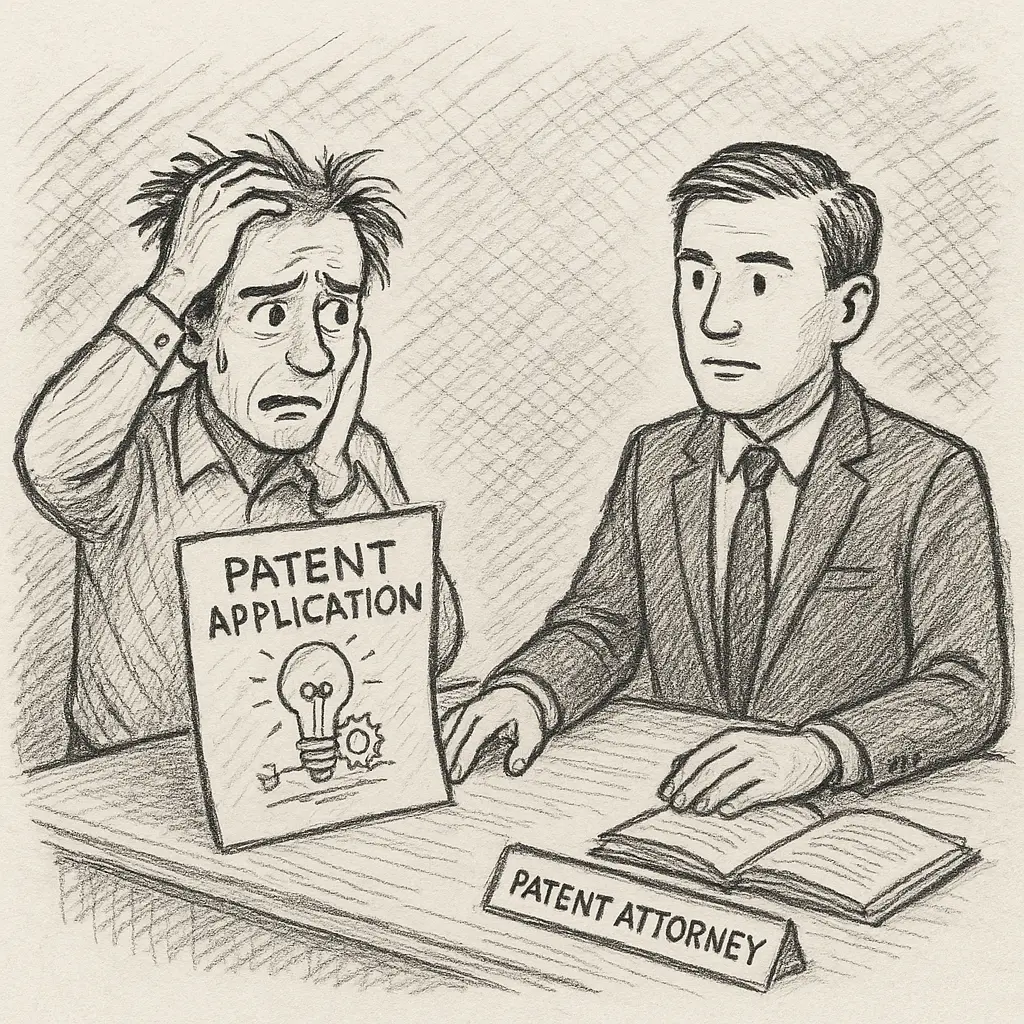
Table of contents
- Summary:
- A Cautionary Tale: How One Inventor Almost Lost It All
- The Allure of the “Do-It-Yourself” Patent
- The Sinking Feeling and the Search for Help
- The Consultation: What I Found
- The Race Against the Clock: The Rescue
- The Road to a Patent
- What This Means for Inventors in the Denver Area
- Conclusion & Next Steps
A Cautionary Tale: How One Inventor Almost Lost It All
During my time as a Denver patent lawyer, I have seen the incredible ingenuity that thrives in this community. There are vibrant ecosystem of startups, engineers, and solo inventors creating truly groundbreaking products. That innovative spirit is something to be celebrated.
However, that same spirit of self-reliance can sometimes be a liability, especially when it comes to the complex world of intellectual property. I often meet inventors who, in an effort of save money or move quickly, try to handle the patent process themselves.
This is the story of one such inventor. Let’s call him “John.”
John’s story is not unique, but it serves as a powerful cautionary tale. Identifying information in this story has been changed to protect the inventor without straying from the underling lesson, because John, like many inventors I have worked with in the Denver area can avoid the kind of stress and risk he endured with a few simple steps.
The Allure of the “Do-It-Yourself” Patent
John was a brilliant engineer. After years of working in his field, he developed a unique piece of technology that he rightly believed could revolutionize his industry. He poured years of his life, not to mention his own money, into developing and refining his prototype.
Excited and eager to protect his idea, John did what many smart, capable people do: he turned to the internet. He read articles and blog posts, watched videos, and visited the U.S. Patent and Trademark Office (USPTO) website.
He learned about the “provisional patent application” (PPA). The online consensus seemed to be that a PPA was a simple, informal, and inexpensive way to get “patent pending” status. “How hard could it be?” he thought. “It’s not the ‘real’ application, just a placeholder.”
This is one of the most dangerous myths in the world of intellectual property.
John spent several weeks drafting his PPA. He wrote detailed descriptions (or so he thought), included some basic drawings he sketched himself, and filed it online. The USPTO accepted his filing, and just like that, he had a filing date and the coveted “patent pending” status. He immediately began planning his next steps: refining the product, building a business plan, and talking to potential investors.
The Sinking Feeling and the Search for Help
About eight months went by. John knew his one-year deadline to file a full, non-provisional utility patent application was approaching. This is the “real” application that gets examined and can become an actual patent.
As he began to prepare, a seed of doubt crept in. The more he read, the more he realized the complexity of what lay ahead. He started to wonder about the PPA he filed. Was it really good enough? What if he missed something? What if his “detailed” description wasn’t detailed in the right way?
The anxiety grew. He had already disclosed his invention to a few potential investors, relying on the “protection” he thought his PPA provided. What if that protection was an illusion?
Panicked, John decided he needed to talk to an attorney. He started searching for a “Denver patent lawyer” with a background in engineering, and thankfully, his search led him to my office.
The Consultation: What I Found
John came in with a thick binder and a worried look. He was smart, organized, and passionate. He explained his invention to me, and I was immediately impressed. But then he showed me the provisional application he had filed.
My heart sank. As a patent attorney, this is the moment I dread. John, in his earnest attempt to do the right thing, had made several critical, and very common, mistakes.
Flaw 1: The Description Lacked Legal Support
John’s description was, as he said, detailed. He explained what his invention did and why it was better than anything on the market. But he failed to meet the two most important legal requirements: written description and enablement.
In simple terms, a patent is a contract. You “teach” the public how to make and use your invention, and in exchange, the government gives you a 20-year monopoly. John’s application described his invention at the level a potential investor might want to hear, but it didn’t teach it from a technical perspective. He failed to describe it with enough specificity for another engineer in his field to replicate it without “undue experimentation.”
He left out details about materials, specific dimensions, and alternative versions (fallbacks) that are important for a strong patent.
Flaw 2: The Drawings Were Insufficient
John’s drawings were simple sketches. Patent drawings are a highly specific technical art. They must show every single feature of the invention that you intend to claim. His drawings were ambiguous and failed to support the full scope of what he had actually invented. If a feature isn’t in the drawings (or the text), you often cannot claim it later.
Flaw 3: The Accidental “Smoking Gun”
This was the most dangerous mistake. In an attempt to be “helpful” and “thorough,” John had included a list of “prior art” (existing technologies) he found and wrote a paragraph explaining why his invention was different and better.
This may sound logical, but in patent law, can come back to haunt you. He had essentially “admitted” what the “closest” prior art was, potentially limiting his own claims before a patent examiner even looked at it. He had created a written record that could be (and likely would be) used against him during examination and later on if his patent was ever challenged.
The Race Against the Clock: The Rescue
I had to be direct with John. His provisional application was, unfortunately, nearly useless. It provided almost no “priority” benefit, meaning his non-provisional application would not be able to rely on the PPA’s early filing date.
This created two big problems for John:
- His “Patent Pending” was an illusion. The PPA didn’t support the invention.
- The Investor Meetings. He had disclosed his invention to investors without a nondisclosure agreement or NDA. If he didn’t act fast, those public disclosures could now be used as “prior art” against his own invention. He was in danger of being barred from patenting his idea at all.
We were in a race against the clock. The one-year bar date (the deadline to file an application after a first public disclosure) was fast approaching. We had to act immediately.
We had to scrap the old PPA entirely. I worked with John day and night for the next two weeks. We conducted intensive interviews, I drafted an entirely new application from scratch, and worked with my professional patent illustrator to create detailed drawings.
This new application was robust. It fully described every aspect of his invention, included multiple variations, and had drawings that supported a broad set of future claims. We filed this new, comprehensive application with only days to spare before his one-year public disclosure bar expired.
We effectively reset the clock, but this time, it was built on a rock-solid foundation.
The Road to a Patent
With a strong provisional patent application now on file, the “patent pending” status on John’s invention finally meant something. He was genuinely protected.
I then worked with John to prepare and file his full non-provisional utility application, which properly claimed priority to the second, well-drafted PPA. The process was smooth because we had done the hard work upfront.
When the patent examiner reviewed the application, the detailed descriptions and professional drawings made prosecution (the back-and-forth negotiation) straightforward. We successfully navigated the examiner’s rejections and, in the end, John’s invention was granted a full U.S. Patent.
John was able to launch his product, secure licensing deals, and build a successful company around his idea. But he never forgot how close he came to losing it all.
What This Means for Inventors in the Denver Area
John’s story had a happy ending, but many do not. His situation is a powerful lesson for all inventors in the Denver area and beyond.
- “Patent Pending” Is Not a Shield. The status itself that you get automatically by filing at the Patent Office means nothing. Its legal power is 100% dependent on the quality of the application it’s attached to. A weak PPA is a ticking time bomb.
- A Patent is a Legal Document First. Your invention is technical, but a patent application is a legal instrument. Engineers are brilliant at the technical, but they are not trained to understand the specific legal language (like “comprising” vs. “consisting of”) or doctrines (like “enablement”) that can make or break a patent.
- Deadlines are Absolute. In patent law, there is no “asking for an extension.” If you miss a one-year statutory bar date, your invention becomes part of the public domain. Forever. You can never get a patent on it.
- A Good Lawyer is an Investment, Not an Expense. John’s “rescue” cost him significantly more in legal fees (and stress) than if he had just come to me in the first place. Doing it right the first time is always cheaper.
Conclusion & Next Steps
Your invention is the product of your hard work, your creativity, and your passion. It is too valuable to leave to chance or to a “simple” online form. John’s story is a testament to the fact that even the smallest, most innocent-looking mistake can jeopardize everything.
If you are an inventor, especially before you disclose your idea to anyone, please consult with a professional.
If you are an inventor in the Denver area with an idea, I invite you to contact my office. Let’s discuss your invention (in complete confidence), and build a solid, strategic foundation for its protection. Don’t wait for a sinking feeling; let’s get it right from the start.
You may also want to read:
